RING-NECKED SNAKE
Diadophis punctatus
DESCRIPTION:
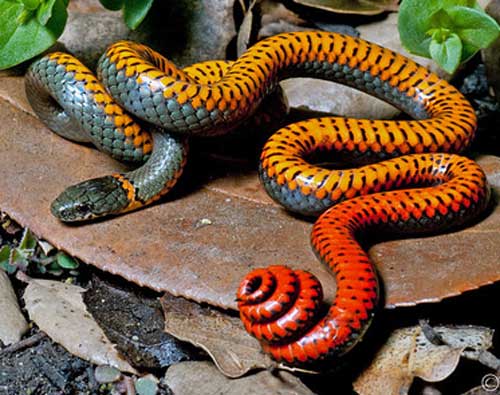
A small to medium (up to 857 mm or 34" in total length), blue-gray to pale gray snake that usually has a cream, yellow, or orange ring on the neck. Some specimens, particularly in western and northwestern Arizona, lack the neck ring.
The head is usually noticeably darker than the body on ringed individuals. The ventral surface grades from bright yellow-orange anteriorly to vibrant red below the tail. Numerous small black bars and spots mark the belly from head to tail. The scales are smooth and the body is uniformly slim and long relative to most other snakes. The pupils are round. The dark markings on its belly and its blue-gray coloration distinguish this snake from the similar looking Chihuahuan Black-headed Snake.
DISTRIBUTION:
This snake is distributed across much of central Arizona and nearly all of southeastern Arizona. Populations (that might be isolated) in Mohave county include the Virgin Mts., lower Grand Canyon, Hualapai Mts. and Black Mts. Another potentially isolated population exists in the Kofa Mts. of Yuma County. In our state this snake has been found at elevations ranging from ca. 2,200' in the low desert ranges of western Arizona to ca. 7,000' above the Mogollon Rim.
HABITAT:
It is found in communities ranging from Mohave Desertscrub and Sonoran Desertscrub into Petran Montane Conifer Forest. This snake is encountered on grassy slopes, bajadas, foothills, canyon bottoms, and low valleys. In the more arid parts of the state it is usually found near drainages, springs, and riparian corridors.
BEHAVIOR: The Ring-necked Snake is a primarily diurnal and crepuscular ground-dweller. It is usually active in the mid-morning or near dusk, avoiding the hottest part of the day. It can be found at any time of day during cloudy and mild conditions. This snake hibernates during the cold months of late fall and winter. When threatened it sometimes coils the tail into a "shield", presenting the bright red underside. Captured individuals often drool from the corner of the mouth, possibly the result of the secretion of venom.
DIET:
Mild venom delivered by enlarged rear teeth in the upper jaw is used to subdue prey which includes a variety of snakes, lizards, and insects.
REPRODUCTION:
Mating takes place in spring. A clutch of up to 18 eggs is laid in late spring or early summer.
|