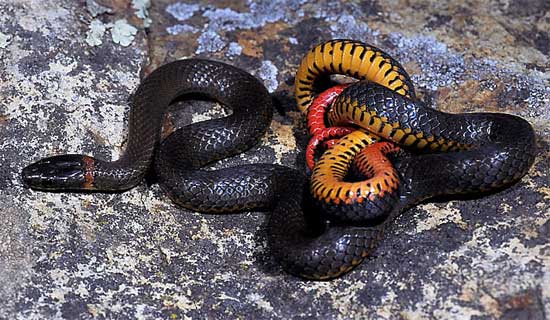
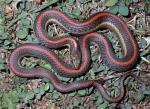
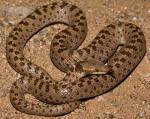
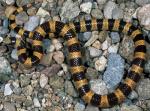
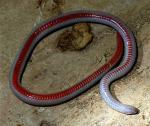
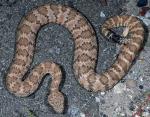
Diadophis punctatus similis - San Diego Ring-necked Snake
Mildly Venomous
Not considered dangerous to humans. Enlarged non-grooved teeth in the rear of the upper jaw and mild venom which may help to incapacitate small prey.
Size
8 - 34 inches long (20 - 87cm.) Most snakes of this subspecies are adult at about 11 - 16 inches (28 - 41 cm.)
Appearance
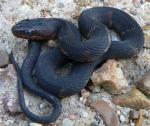
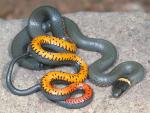
A small, thin snake with smooth scales. Gray, blue-gray, blackish, or dark olive dorsal coloring, with a yellowish or light orange underside that is lightly speckled with black markings. The underside of the tail is a bright reddish orange. An orange band around the neck 1.5 - 3 scales wide.
Behavior
Secretive - usually found under the cover of rocks, wood, bark, boards and other surface debris, but occasionally seen moving on the surface on cloudy days, at dusk, or at night.
When disturbed, coils its tail like a corkscrew, exposing the underside which is usually bright red. It may also smear musk and cloacal contents.
Diet
Eats small salamanders, tadpoles, small frogs, small snakes, lizards, worms, slugs, and insects. The mild venom may help to incapacitate prey.
Reproduction
Lays eggs in the summer, sometimes in a communal nest.
Range
This subspecies, Diadophis punctatus similis - San Diego Ring-necked Snake, is found mainly in San Diego County along the coast and into the Peninsular range, and in southwestern San Bernardino County. Ranges south barely into northern Baja California, Mexico.
The species Diadophis punctatus - Ring-necked Snake, has a very wide range, occuring along the entire east coast of the United States west to the Great Lakes and southwest from there through the Midwest into Arizona, with scattered isolated populations throughout most of the western states including the western half of California, Oregon west of the Cascades, and south central Washington.
Habitat
Prefers moist habitats, including wet meadows, rocky hillsides, gardens, farmland, grassland, chaparral, mixed coniferous forests, woodlands.
Taxonomic Notes
Many herpetologists no longer recognize the traditional morphologically-based subspecies of Diadophis punctatus, pending a thorough molecular study of the whole species. One ongoing study (Feldman and Spicer, 2006, Mol. Ecol. 15:2201-2222) has found all of the D. punctatus subspecies in California (except D. p. regalis) to be indistinguishable. It is likely that D. punctatus is composed of several distinct lineages that do not follow the geographic ranges of the subspecies.
|