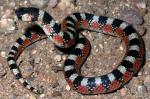
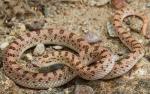
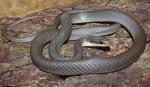
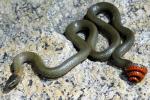
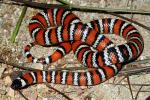
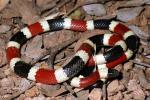
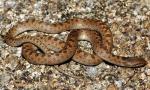
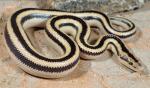
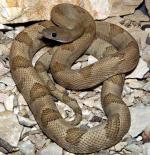
Lampropeltis getula splendida - Desert Kingsnake
DESCRIPTION:
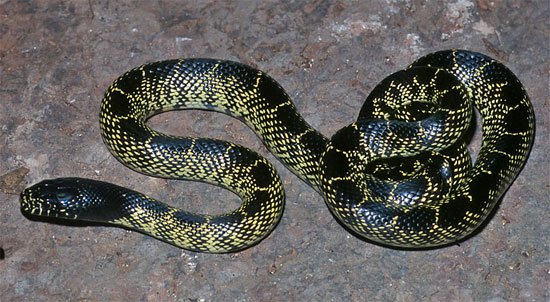
The Desert Kingsnake (Lampropeltis getula splendida) is a subspecies of kingsnake native to Texas, Arizona and New Mexico. It is nonvenomous, colored yellow and black. The desert kingsnake's diet consists of rodents, lizards, and smaller snakes, including rattlesnakes.
They normally grow 3–4 feet long with a maximum length of 6.8 feet. They are docile creatures when coming face to face with humans. If they do not try to escape, often they will "play dead" by flipping over onto their backs and lying motionless. It has been reported that if a pretending snake is flipped back into its natural position, it will flip itself over again[citation needed], defeating the purpose of pretending to be dead. Some who domesticate kingsnakes, such as ranchers, do so in the hopes that the kingsnakes will feed on other snakes which might present more of a threat.
Appearance
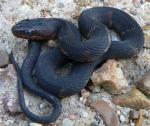
The snake's glossy dorsum is black or very dark brown, finely speckled with off-white or yellow. These pale flecks form dimly-defined narrow vertebral crossbands, between which the intervening rectangular areas are black. Pale yellow scales may predominate along the lower sides. The abdomen of both adult and young snakes is mostly black, with white or pale yellow blotches marking the outer ends of the ventral plates. The smooth dorsal scales are arranged in 23 to 25 rows at midbody and the anal plate is undivided.
Habitat
The desert kingsnake may occur in any rural habitat within its range. Despite its common name, it is most likely to be found in mesic areas, especially near water tanks or within riparian corridors.
Prey
This snake is known to be a powerful constrictor, and therefore its diet consists of mostly mice if domestic, and other rodents if wild. It also can feed on clutches of reptile eggs detected beneath the surface via smell. In part because of its resistance to pitviper venom, the desert kingsnake is able to consume young diamondback rattlesnakes that are common within its range, and at the scent of L. getula even adult western diamonbacks edge hastily backward, shielding their heads with defensive loops.
[edit]
Reproduction
As with most reptiles, L. g. splendida lays eggs. Courtship and copulation occurs between the months of March and June, with clutches of 5 to 12 adhesive-surfaced eggs deposited in late June or July, sometimes buried as deeply as a foot to prevent drying through their moisture-permeable shells. After about 60 days of incubation the 8- to 10-inch long hatchlings, weighing about a fifth of an ounce, emerge. Brightly yellow-speckled in vertebral cross-lines, they also exhibit a lateral row of large, dark brown spots which, as they mature, are gradually fragmented by encroaching yellow flecks.
|