Agaricus fusco-fibrillosus
Pileus
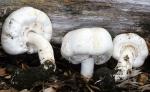
Cap 4-15 cm broad, convex, becoming nearly plane in age, usually slightly umbonate at the disc; surface dry, appressed silky-fibrillose, occasionally with flattened scales, coco-brown to reddish-brown; flesh moderately thick, firm, white, soon reddening when cut; odor, strongly of "mushrooms"; taste mild.
Lamellae
Gills close, free, moderately broad, pinkish-brown becoming chocolate-brown to nearly black.
Stipe
Stipe 4-15 cm tall, 1.5-2.5 cm thick, equal to enlarged or bulbous at the base, stuffed, hollow at maturity; surface smooth to faintly fibrillose, white, discoloring brown in age, with one to several coco-colored, thin bands at the base; partial veil membranous, white, forming a superior pendulous veil, the margin pale brown; flesh white, fibrous, staining red when cut.
Spores
Spores 5-6.5 x 3.5-4 µm, smooth, elliptical; spore print dark chocolate brown.
Habitat
Gregarious to clustered under Monterey cypress; fruiting from mid to late winter.
Edibility
Edible and excellent, an opinion shared by the fly larva which frequently infest this mushroom.
Comments
Agaricus fusco-fibrillosus is one of our more distinctive Agaricus species. The ruddy-brown, appressed silky-fibrillose cap, and pale, thin brown bands seen at the base of the stipe help to distinguish it from other red-staining, cypress dwelling Agaricus species. Agaricus pattersonae is a larger, more robust relative of A. fusco-fibrillosus. Like Agaricus fusco-fibrillosus, it has thin brown collars at the base, but the cap has appressed, brown squamules and is not fibrillose. This species seems to be most abundant in old cypress groves close to the ocean. Another red-stainer, Agaricus fuscovelatus, has a more conic cap with brownish scales, a cocoa-colored veil, and tends to grow in caespitose clusters. Finally, Agaricus benesi, although a red-stainer, is a white mushroom, at least when young, and can be found as often with Monterey pine as with Monterey cypress.
|

.jpg "Marasmius calhouniae")
.jpg "Turbinellus kauffmanii")
.jpg "Clavariadelphus caespitosus")
.jpg "Collybia acervata: Gymnopus acervatus")
.jpg "Cantharellus formosus")
.jpg "Morchella deliciosa")
.jpg "Trametes versicolor")
.jpg "Hygrocybe coccinea")
.jpg "Stropharia riparia")
.jpg "Boletus piperatoides: Chalciporus piperatoides")
.jpg "Peziza repanda")
.jpg "Clavariadelphus occidentalis")
.jpg "Lepiota atrodisca")
.jpg "Melanoleuca angelesiana")
.jpg "Hygrophorous subalpinus")
.jpg "Podaxis pistillaris")
.jpg "Sarcoscypha coccinea")
.jpg "Ramariopsis kunzei")
.jpg "Crinipellis piceae")