Amanita constricta
Pileus
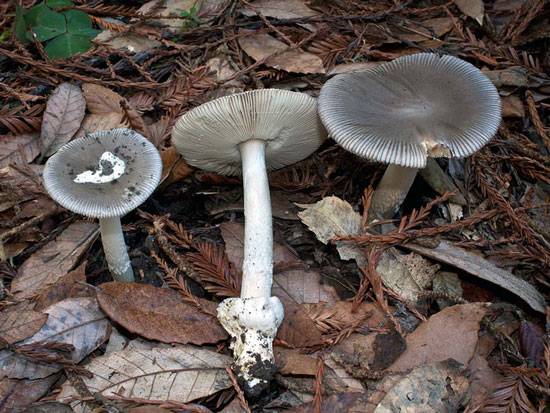
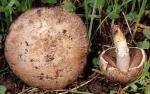
Cap 6.0-12.0 cm broad, convex, expanding to nearly plane at maturity, sometimes with a low umbo; margin incurved, then decurved to straight, conspicuously striate; surface moist, viscid in wet weather, glabrous, grey to brownish-grey, often with patches of whitish to pale-grey universal veil tissue, the latter bruising reddish-brown when fresh; context whitish to pale-grey, soft, up to l.5 cm thick at the disc, elsewhere thin, unchanging when injured; odor mild, of fish in age; taste mild.
Lamellae
Gills free, close to crowded, up to 1.0 cm broad, whitish to pale-grey, the edges usually darker and appearing fringed when viewed with a hand lens; lamellulae up to four-seried.
Stipe
Stipe 9.0-17.0 cm long, 1.0-2.0 cm thick, more or less equal, or narrowed toward the cap, stuffed at maturity; surface of apex whitish, pruinose, the ornamentation striate; lower stipe covered with fine grey-brown scales, becoming more coarse toward the base; volva membranous, saccate, bruising reddish-brown where handled, fused to the stipe except for a flaring margin; partial veil absent.
Spores
Spores 9.5 x 11.5 x 8.5-10 µm, subglobose, smooth, thin-walled, inamyloid; spore print white.
Habitat
Solitary to scattered under hardwoods such as oaks (Quercus spp.) or with Tanbark oak (Lithocarpus densiflora); fruiting from after the fall rains to mid-winter.
Edibility
Edible, but see "Comments".
Comments
Amanita constricta is a close relative of A. vaginata, A. pachycolea, and A. protecta. Commonly known as "grisettes," members of this group have greyish to brown caps, lack an annulus, possess inamyloid spores, and have a universal veil that tends to bruise ochre or reddish-brown. Amanita constricta is distinguished from the above by a distinctive, membranous volva. Unlike the typical saccate volva which is attached only at the stipe base and then expands outward to form a cup, the volva of Amanita constricta is fused to the stipe except for a flaring margin. To distinguish other "grisettes," see "Comments" under Amanita vaginata. Amanita constricta is an edible species, but caution is advised as at least two deadly Amanitas with saccate type volvas occur in the S. F. Bay Area: Amanita phalloides, "Death Cap" and Amanita ocreata.
|
.jpg "Lepista tarda: Clitocybe tarda")
.jpg "Scleroderma cepa")
.jpg "Macrocystidia cucumis")
.jpg "Phellinus igniarius")
.jpg "Gyromitra californica: Pseudorhizina californica")
.jpg "Tricholoma dryophilum")
.jpg "Hypholoma fasciculare")
.jpg "Xeromphalina cauticinalis")
.jpg "Cryptoporus volvatus")
.jpg "Plicaria endocarpoides")
.jpg "Lentinus torulosus: Panus conchatus")
.jpg "Chroogomphus tomentosus")
.jpg "Ramaria myceliosa")
.jpg "Psilocybe cyanescens")

.jpg "Russula olivacea")
.jpg "Floccularia albolanaripes")
.jpg "False Morel: Gyromitra esculenta")
.jpg "Peziza violacea")
.jpg "Lactarius rubrilacteus")