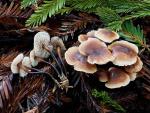
Arrhenia epichysium
Synonym: Omphalina epichysium (Persoon) Quélet
Pileus
Cap 1.0-3.0 cm broad, convex-depressed to infundibuliform; margin incurved, then decurved; surface translucent-striate, hygrophanous, grey-brown to dingy-brown, fading to lighter shades, glabrous except furfuraceous at the center; context thin, approximately 1.0 mm thick, watery-brown, unchanging; odor and taste mild.
Lamellae
Gills decurrent, fairly well-spaced, relatively broad, up to 3.0 mm wide, light-grey, paler than the cap and stipe; lamellulae in three to four series.
Stipe
Stipe 1.0-2.5 cm long, 2.0-3.0 mm thick, more or less equal, hollow-stuffed in age, frequently white-tomentose at the base; surface glabrous, watery greyish-brown; partial veil absent.
Spores
Spores 7.0-8.5 x 4.0-4.5 µm, elliptical to elliptical-oblong in face-view, slightly inequilateral in profile, smooth, thin-walled, hilar appendage inconspicuous, contents granular, inamyloid; spores deposit not seen.
Habitat
In small groups on hardwood and conifer logs; fruiting from late fall to mid-winter in coastal and foothill forests of the Sierra Nevada, again in the spring at higher elevations.
Edibility
Unknown.
Comments
Once an Omphalina, now placed in Arrhenia as a result of molecular studies, this small drab mushroom is recognized by a greyish-brown, umbilicate to funnel-shaped, grey-brown, striate cap, and lignicolous habit. Several Omphalina spp. (sensu lato) are similar, but can be separated by their different fruiting habits, i.e. on soil or in mossy areas. Arrhenia epichysium is sometimes confused with Lichenomphalia umbellifera, traditionally known as Omphalina ericetorum or Gerronema ericetorum. It also occurs occasionally on well decayed wood, but differs in a pale-brown to yellowish-brown, not grey to grey-brown cap. Additionally, as suggested by the genus name, it is actually a lichenized fungus, i.e. forms a symbiotic relationship with an alga. Evidence of this association can sometimes be seen as clumps of algae at the base of the stipe.
|

.jpg "Suillus ponderosus")
.jpg "Elaphomyces granulatus")
.jpg "Lichenomphalia umbellifera")
.jpg "Plectania nannfeldtii")
.jpg "Coprinus comatus")
.jpg "Pluteus flavofuligineus")
.jpg "Cortinarius ponderosus")
.jpg "Mycenastrum corium")
.jpg "Inocybe corydalina")
.jpg "Stereum ochraceo-flavum")
.jpg "Schizophyllum commune")
.jpg "Ceriporia spissa")
.jpg "Gymnopus bakerensis")

.jpg "Gautieria pterosperma")

.jpg "Ramaria gelatiniaurantia")
.jpg "Bulgaria inquinans")