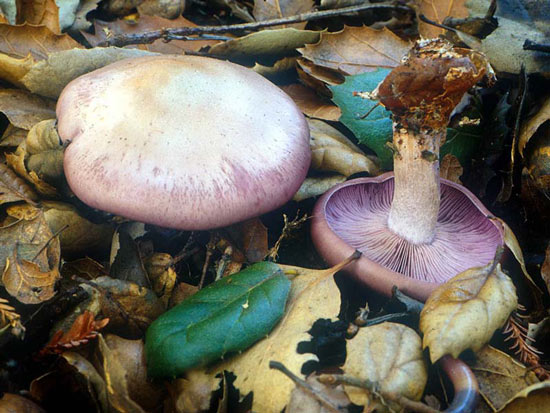
Blewitt: Clitocybe nuda
Synonym: Lepista nuda (Bullard:Fries) Cooke
Pileus
Cap 4-14 cm broad, convex, becoming nearly plane in age, margin inrolled, wavy, sometimes upturned at maturity; surface smooth, moist, violet to lilac, fading to tan; flesh soft, pale-lilac; odor fragrant, taste mild.
Lamellae
Gills adnexed, notched to subdecurrent, close, moderately broad, violet to lilac, fading in age to tan or light-brown.
Stipe
Stipe 3-6.5 cm long, 1-2.5 cm thick, equal to enlarged or bulbous at the base, the latter frequently with adhering lilac to purple mycelium; surface fibrillose to slightly scaly, colored like the cap, veil lacking.
Spores
Spores 6-8 x 4-5 µm, elliptical, minutely roughened; spore print pale pinkish-buff.
Habitat
Fruiting singly, gregariously, or in fairy rings under a variety of hardwoods and conifers; appearing from late fall to mid-winter; depauperate fruitings are occasionally seen along the coast during the summer, the result of fog drip.
Edibility
Edible and considered good by many, but lacking somewhat in texture. Local material varies greatly in it's taste, from quite good to very poor. Known to cause gastrointestinal upsets if eaten raw.
Comments
Clitocybe nuda is probably the Bay Area's most common edible mushroom fruiting abundantly in urban parks and to a lesser extent in natural habitats. It is recognized by a purple to lilac, smooth, almost waxy, wavy-margined cap which fades to tan, the lack of a veil, a faint fragrant odor, and pale pinkish-buff spore print. Lilac-colored mycelium is often found at the base of blewits. Those collecting for the table should be aware of several other lilac to purple mushrooms that occur locally: Laccaria amethysteo-occidentalis which can be told by its distinctly fibrous stipe, Mycena pura, a smaller mushroom with a striate cap margin and white spores, and Inocybe geophylla var. lilacina, also a small mushroom, which has brown spores and a green-corn odor. In addition, there are several violet to lilac-colored Cortinarius species, but all of these have a cob-web type of veil and rusty-brown spores.
|
.jpg "Cantharocybe gruberi")
.jpg "Parrot Mushroom: Hygrocybe psittacina")
.jpg "Nolanea verna var. isodiametica")
.jpg "Calocybe onychina")
.jpg "Lachnellula arida")
.jpg "Macrocystidia cucumis")
.jpg "Ramaria botrytis")
.jpg "Coprinus sterquilinus")
.jpg "Hebeloma mesophaeum")
.jpg "Gautieria pterosperma")
.jpg "Catathelasma imperiale")
.jpg "Turbinellus kauffmanii")
.jpg "Stropharia semiglobata")
.jpg "Psilocybe coprophila")
.jpg "Galeropsis polytrichoides")
.jpg "Clitocybe sclerotoidea")
.jpg "Galerina autumnalis")
.jpg "Microglossum viride")
.jpg "Psathyrella echiniceps")
.jpg "Exidia nucleata")