Bolbitius aleuriatus
Pileus
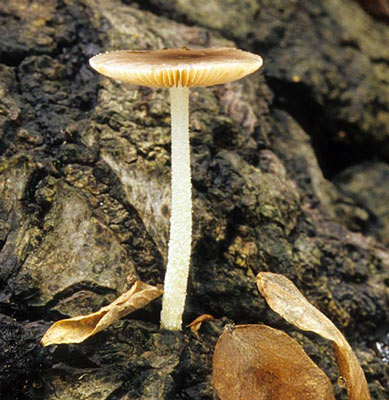
Cap 1.5-3.0 cm broad, convex to campanulate, expanding to nearly plane, sometimes centrally depressed or with a low umbo; margin striate-plicate, decurved when young, plane to slightly raised in age; surface viscid when moist, disc glabrous to reticulate, greyish-brown to greyish-purple, shading to a light-grey margin; context white, unchanging, soft, thin, up to 2 mm thick; odor and taste not distinctive.
Lamellae
Gills adnexed, sometimes appearing free, close to crowded, narrow, 2.0-3.0 mm broad, pallid to faintly pinkish when young, buff-brown to ochre-brown, occasionally tinged rusty-brown at maturity; lamellulae 3-4 seried, edges minutely fringed.
Stipe
Stipe 1.5-3.0 cm long, 1.5-3.0 mm thick, more or less equal, fragile, hollow to stuffed at maturity; surface moist, pallid to cream-yellow, pruinose to furfuraceous at the apex, less conspicuously ornamented towards the base, in age sometimes weathering away and appearing glabrous; partial veil absent.
Spores
Spores 8.5-11.0 x 4.5-6 µm, broadly ellipsoid, smooth, relatively thick-walled, with an apical pore, hilar appendage not evident; spore print brown to dull reddish-brown.
Habitat
Mostly solitary on well-rotted wood; fruiting from late fall to mid-winter.
Edibility
Unknown, insignificant.
Comments
Bolbitius aleuriatus is a widely distributed but inconspicuous woodland species. A delicate mushroom, it is recognized by a viscid when moist, striate, greyish-purple cap, ochre-brown, sometimes tinged rusty-brown gills, and a pruinose to furfuraceous ornamented stipe. Closely related is Bolbitius reticulatus which differs primarily in having a cap with a rivulose-textured disc. These two species appear to intergrade with respect to the cap character and for that reason some authors regard Bolbitius reticulatus as conspecific with B. aleuriatus. We have adopted this view and included those forms with a textured cap in the above description. Bolbitius aleuriatus is most likely to be confused with Pluteus longistriatus, another small wood-rotter with a striate margin, but it can be distinguished by a typically brown, non-viscid cap, free gills which are pinkish at maturity, and a pinkish, not brown to reddish-brown spore print.
|
.jpg "Psilocybe montana")
.jpg "Inocybe brunnescens")
.jpg "Strobilurus albipitatus")
.jpg "Tricholoma atroviolaceum")
.jpg "Bulgaria inquinans")
.jpg "Coriolus versicolor: Trametes versicolor")
.jpg "Dacrymyces capitatus")
.jpg "Stereum ochraceo-flavum")
.jpg "Sedecula pulvinata")
.jpg "Handkea subcretacea")
.jpg "Melanoleuca lewisii")
.jpg "Mycena adonis")
.jpg "Mycena adscendens")
.jpg "Clavulina cinerea")
.jpg "Collybia butyracea: Rhodocollybia butyracea")
.jpg "Hypholoma fasciculare")
.jpg "Spinellus fusiger")

.jpg "Calvatia cyathiformis f. fragilis")