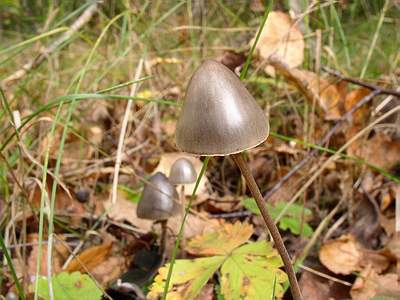
Panaeolus campanulatus: Panaeolus papilionaceus
Pileus
Cap 1.5-4.0 cm broad, obtusely conic, becoming bell-shaped; margin at first slightly incurved, then decurved, decorated with white veil fragments, the latter sometimes obscure in age; surface smooth, dry, subviscid in moist weather, olive-brown to grey-brown, occasionally yellowish-brown to reddish-brown at the disc; flesh greyish to buff-brown, thin; odor mild.
Lamellae
Gills adnate to adnexed, sometimes seceding, close, broad, pale grey, the faces mottled darker from maturing spores, edges pallid; in age blackish overall.
Stipe
Stipe 6-12 cm long, 2-4 mm thick, slender, fragile, hollow, more or less equal but sometimes slightly enlarged at the apex and base; surface striate above, otherwise pruinose (at least when young), grey-brown, darker where handled; partial veil fibrillose-membranous, white, evanescent, leaving fragments on the pileal margin.
Spores
Spores 12-17 x 7-10 µm, elliptical, smooth, with an apical pore; spore print black.
Habitat
Fruiting singly or in small groups on cow/horse manure and in pastures; fruiting spring and fall.
Edibility
Not recommended; probably not toxic, but related species may be mildly hallucinogenic.
Comments
Panaeolus papilionaceus is characterized by a grey-brown, smooth bell-shaped cap with appendiculate margin, dark mottled gills with whitish edges, a slender, fragile stipe and a habit of growing on horse/cow dung or in herbivore-enriched pastures. Until recently, this species was a part of a confusing group mushrooms that included Panaeolus campanulatus, P. sphrinctrinus and P. retirugis. However, work by Gerhardt (1996) indicates the latter are conspecific, P. papilionaceus being the oldest valid name. Another dung inhabiting Panaeolus that may be encountered in our area is P. semiovatus a relatively large species which has a smooth, pale colored cap and an annulus.
|
.jpg "Clitopilus prunulus")
.jpg "Leccinum manzanitae")

.jpg "Camarophyllus pratensis")
.jpg "Pluteus atromarginatus")
.jpg "Clavaria vermicularis")
.jpg "Boletus regius")
.jpg "Gymnopus acervatus")
.jpg "Lepista tarda: Clitocybe tarda")
.jpg "Russula densifolia")
.jpg "Helvella lacunosa")
.jpg "Inocybe pudica")
.jpg "Coriolus versicolor: Trametes versicolor")


.jpg "Pholiota velaglutinosa")
.jpg "Lepiota cepaestipes: Leucocoprinus cepaestipes")
.jpg "Lactarius deliciosus")
.jpg "Tricholoma atroviolaceum")
.jpg "Polyporus elegans")
.jpg "Inocybe adaequata")
.jpg "Peziza vesiculosa")