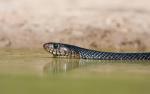
Nerodia taxispilota - Brown Watersnake
Description:
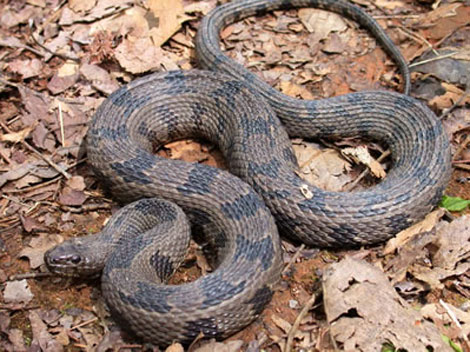
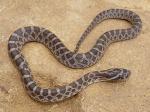
Average adult size is 30-55 inches (76.2-139.7 cm), record is 69.5 inches (176.5 cm). Adults are light tan with darker squarish brown blotches on the back.
Dark squarish markings extend upwards from the belly onto the sides of the body between the dorsal blotches. The belly is light-colored with darker blotches and half moons. The scales are keeled and there are 25-33 dorsal scale rows at midbody. The pupil is round. Juvenile coloration is similar to that of adults.
Range:
In Florida, the Brown Water Snake is found throughout the state, excluding the Florida Keys. Outside of Florida, it is found from southern Alabama northeast to southeastern Virginia.
Habitat:
Commonly found in rivers, cypress strands, sawgrass prairies, swamps, lakes, ponds, canals, and flooded stands of melaleuca.
Comments:
HARMLESS (Non-Venomous). The Brown Water Snake is a good climber and can found 20 feet up in trees, though it is most frequently seen basking on tree limbs that extend above the water. When frightened by a rapidly approaching boat, it will escape by jumping off the limb into the water. Occasionally its attempt to flee comes too late and they fall not into the water, but into the boat.
It feeds on fishes, frogs, and carrion. It is live-bearing, with up to 60 young being recorded. The 7-11 inch (17.7-27.9 cm) newborns are deposited from June-October.
Comparison with other species: The Southern Water Snake (Nerodia fasciata) has a darker colored body with dorsal crossbands that extend over the back, squarish markings on the belly, and a dark stripe from its eye to last supralabial scale. The Midland Water Snake (Nerodia sipedon pleuralis) has fewer than 30 darker brown crossbands near the neck, which break up into alternating blotches further down the body, and the belly is yellowish with two rows of half moons.
Because both are found around lakes and ponds, harmless Brown Water Snakes are often confused with the venomous Cottonmouth (Agkistrodon piscivorus). However, Cottonmouths can easily be distinguished from watersnakes. The Cottonmouth has a vertical pupil, a facial pit between its eye and nostril. If the head is viewed from above, the eyes of Cottonmouths cannot be seen while the eyes of Water Snakes are visible; Cottonmouths have elliptical pupils and Water Snakes have round pupils; and Cottonmouths have a facial pit between the nostril and the eye, which the Water Snakes do not.
|