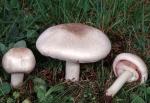
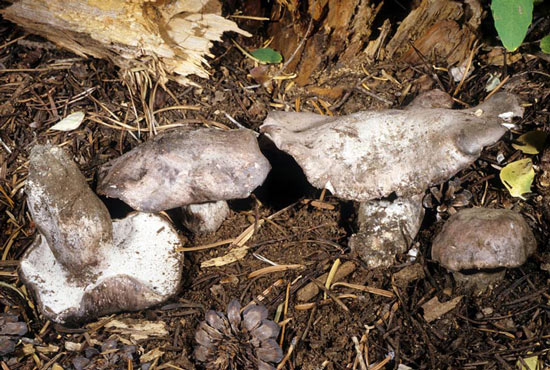
Boletopsis subsquamosa: Boletopsis leucomelaena
Pileus
Cap 5.0-13.0 cm broad, convex, broadly so in age, often irregular with depressed and raised areas; margin incurved, then decurved, wavy; surface dry, glabrous to patchy appressed-fibrillose, pallid when unexposed, soon greyish to blackish-brown, sometimes with purplish tints, darker where handled; context white, firm, up to 3.0 cm thick at the disc, unchanging to slowly pale-grey; odor mild to fragrant; taste frequently bitter.
Hymenophore
Pores fine, 3-4/mm, mostly angular, whitish, darkening when bruised; tube layer subdecurrent, 1.0-3.0 mm thick, not readily separable from the cap context.
Stipe
Stipe 3.0-8.0 cm long, 2.0-4.0 cm thick, solid, central or eccentric, equal to ventricose, the base often pointed; surface colored like the cap but usually lighter, glabrous to squamulose, bruising dark greyish-brown; context white, firm, unchanging when cut except greyish at the base; partial veil absent.
Spores
Spores 5.0-6.0 x 4.0-5.0 µm, subglobose with a nodulose surface, inamyloid; spores hyaline to pale-tan in deposit.
Habitat
Solitary, scattered, or in cespitose clusters in mixed hardwood-conifer woods; fruiting from late fall to mid-winter in coastal and montane forests; widely distributed; uncommon.
Edibility
Edible but frequently bitter. The Japanese soak this mushroom in brine to remove the bitterness. Long boiling does not reduce the bitter flavor.
Comments
As the genus name suggests, this fleshy, grey, polypore mimics members of the bolete group, e.g. species of Suillus, Boletus, Leccinum, etc. As a polypore, however, it possesses a less putrescent context and tube layer that is not readily separable from the cap. Boletopsis leucomelaena is most likely to be confused with other fleshy, terrestrial polypores, two of which are Albatrellus flettii and Jahnoporus hirtus. The former differs in having a bluish cap, and salmon-colored pores in age, while Jahnoporus hirtus has a grey-brown, occasionally purple-brown, tomentose cap. Microscopically, Boletopsis leucomelaena is easily distinguished by its nodulose spores.
|
.jpg "Mitrula elegans")
.jpg "False Chanterelle: Hygrophoropsis aurantiaca")
.jpg "Clavariadelphus caespitosus")
.jpg "Pluteus pouzarianus")
.jpg "Hymenogaster utriculatus")
.jpg "Lactarius argillaceifolius var. megacarpus")
.jpg "Laccaria fraterna")
.jpg "Ramaria myceliosa")
.jpg "Xylaria hypoxylon")
.jpg "Marasmius androsaceus")
.jpg "Russula aeruginea")
.jpg "Gymnopus bakerensis")
.jpg "Dacrymyces capitatus")
.jpg "Marasmius calhouniae")
.jpg "Chrysomphalina chrysophylla")
.jpg "Omphalina epichysium: Arrhenia epichysium")