Marasmius androsaceus
Pileus
Cap 3-8 (10) mm broad, convex, becoming plano-convex, the disc slightly depressed to umbilicate; margin incurved in youth, then decurved, crenate; surface dry, dull, more or less glabrous, at first dark-brown, to dark reddish-brown, remaining so at the disc, fading to medium-brown or buff-brown at the margin, the latter sparsely covered with a buff-colored pubescence in youth; context thin, < 1 mm thick, cream-colored; odor and taste mild; fruiting bodies capable of reviving after drying.
Lamellae
Gill close to subdistant, adnate, narrow, pale apricot-tan in youth, darkening slightly with age; edges lighter than the faces, minutely fringed; lamellulae in two to three series.
Stipe
Stipe 25-50 mm long, 0.5-1.0 mm thick, filiform, hollow, equal, round to flattened; surface reddish-brown at apex, blackish below, more or less glabrous but with innate fibrils when viewed with hand lens; short, stub-like branches covered with a buff tomentum occasionally seen at base; numerous hair-like, black rhizomorphs interspersed with fruiting bodies; partial veil absent.
Spores
Spores 6.5-8.0 x 3.5-4.5 microns, ellipsoid, thin-walled, smooth, hilar appendage conspicuous; spores inamyloid, deposit not seen.
Habitat
Gregarious on needle litter of coast redwood (Sequoia sempervirens), pines (Pinus spp.), occasionally with hardwoods; fruiting after fall rains into mid-winter; common, inconspicuous.
Edibility
Unknown; too small to have culinary value.
Comments
This litter decomposer often occurs in large groups but is easily overlooked.The tiny caps are dark-brown to reddish-brown, striate-rugulose, typically depressed at the disc, the stipes blackish, generally smooth and wire-like, with abundant black hair-like rhizomorphs permeating the duff. Two similar Marasmius species are M. quercophilus and M. pallidocephalus. Marasmius quercophilus, found on leaves of oak (Quercus spp.) and tanbark oak (Lithocarpus densiflorus), has a pallid, rugulose-striate cap with a pale-brown disc and a hair-thin, dark-brown stipe. Marasmius pallidocephalus also has a paler cap, i.e. lighter shades of brown and can be distinguished partly by its substrate preference, conifer needles other than those favored by M. androsaceus, namely Douglas fir (Pseudotsuga menziesii), true firs (Abies spp.), hemlock (Tsuga spp,) and Sitka spruce (Picea sitchensis). Microscopically, the absence of cheilocystidia in Marasmius pallidocephalus, present in M. androsaceus, is an important differentiating character. Unrelated but similar to Marasmius androsaceus is Micromphale sequoiae. It also fruits on redwood litter, and mimics it in size and color, but has a latent garlic taste. Additionally it has a pubescent, not smooth stipe, and lacks abundant rhizomorphs in the surrounding duff.
|
.jpg "Marasmius androsaceus")
.jpg "Hypomyces cervinigenus")
.jpg "Paxillus involutus")
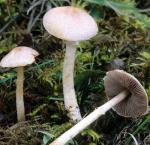
.jpg "Psathyrella echiniceps")
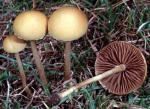
.jpg "Tricholoma imbricatum")
.jpg "Calvatia subcretacea: Handkea subcretacea")
.jpg "Laccaria laccata var. pallidifolia")
.jpg "Ramaria rasilispora var. scatesiana")
.jpg "Plicaria endocarpoides")
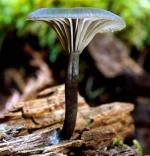
.jpg "Marasmius plicatulus")
.jpg "Lenzites betulina")
.jpg "Omphalina epichysium: Arrhenia epichysium")
.jpg "Marasmius calhouniae")
.jpg "Volvariella speciosa")
.jpg "Hygrophorus hypothejus")
.jpg "Micromphale arbuticola")
.jpg "Tapinella panuoides")