Cantharellus cibarius
Pileus
Cap 3-11 cm broad, peg to vase-shaped, the disc frequently depressed but not funnelform; margin incurved, wavy, in age decurved, plane, to upturned; surface smooth or with appressed hairs, dry, yellow to golden-yellow, fading in age; flesh yellowish, thick, firm; odor faintly fruity, taste mild.
Lamellae
Gills reduced to ridges, decurrent, forking, often cross-veined or anastomosing, colored like the cap or lighter.
Stipe
Stipe 2-9 cm long, 0.5-3.5 cm thick, tapering to a narrowed base; surface dry, smooth, concolorous or lighter than the cap.
Spores
Spores 8-11 x 4-5.5 µm, elliptical, smooth; spore print pale yellow.
Habitat
Gregarious, clustered, or in fairy-rings, under Quercus agrifolia (coast live oak), less commonly with Lithocarpus densiflorus (tanbark oak) and Umbellularia californica (California bay); fruiting from fall to early spring; occasionally along the coast in late summer from fog drip.
Edibility
Edible and choice; keeps well, and is seldom infested with fly larva.
Comments
This much sought-after edible is recognized by a fleshy, yellow, vase-shaped, fruiting body, wavy margin, and shallow, ridge-like gills that are conspicuously decurrent. Unfortunately for mycophagists, it often grows well protected in a thick understory of Toxicodendron diversilobum (poison oak). Collectors should be aware that other yellow mushrooms are occasionally mistaken for the chanterelle, notably Hygrophoropsis aurantiaca (false chanterelle), Ompahlotus olivascens (jack o'lantern fungus), and Gomphus floccosus (wooly chanterelle). Hygrophoropsis aurantiaca is a less fleshy, buff to orangish, probably edible species that grows on rotting wood or wood chips; an important field character is its dichotomously branched, brightly colored, true gills. Omphalotus olivascens, a toxic species, usually has an eccentric stipe, a yellowish-olive color, true gills, and grows either on rotting wood or at the base of hardwoods. Gomphus floccosus is a chanterelle relative which can cause stomach upsets. It also has a vase-like shape, but can be distinguished by a cap which has a hollow center surrounded by orange scales. Also in California is Cantharellus subalbidus, an excellent edible species that differs from C. cibarius in being pallid to almost white in color and having white spores.
|
.jpg "Cantharellus cibarius")
.jpg "Inocybe geophylla var. geophylla")
.jpg "Candy Cap: Lactarius rubidus")
.jpg "Marasmius androsaceus")
.jpg "Gomphidius glutinosus")
.jpg "Phellinus igniarius")

.jpg "Hericium erinaceus")
.jpg "Mycena pura")
.jpg "Tremellodendropsis tuberosa")
.jpg "Hygrophorus caeruleus")
.jpg "Suillus megaporinus")
.jpg "Ramariopsis kunzei")
.jpg "Psilocybe montana")
.jpg "Microglossum viride")
.jpg "Cannon Fungus: Sphaerobolus stellatus")
.jpg "Suillus brevipes")
.jpg "Mycena abramsii")
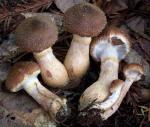
.jpg "Galerina autumnalis")
.jpg "Russula mustelina")
.jpg "Hypholoma aurantiaca: Leratiomyces ceres")
.jpg "Hygrophorus gliocyclus")
.jpg "Clitocybe inversa")
.jpg "Rimbachia bryophila")